The Method
Pressure testing the in home system
Pressure testing is the main check for your indoor pipes. The specialist splits the system at the points that can be reached. Those points are manifolds, shutoffs, and groups of fixtures. One section at a time gets pressurized and watched. A sound section holds its reading. A failing section drops. How fast it drops shows the size of the loss. Then the sections get split smaller and smaller, until the failing run is the smallest stretch that can be tested. Under the floor, this same testing helps confirm a slab leak.
The split follows the shape of the home. Hot and cold lines are tested apart first. Then the system divides by floor, by wing, or by bathroom group. Each split halves the ground the loss can hide in. A section that holds its pressure is closed off and left alone. Only the falling section gets split again. The readings are written at every step. That written trail is what later proves the result.
The test has one honest limit. A falling section proves water is leaving that section. It does not name the exact joint or fitting. Once the run is small enough, the technician listens along it and reads the signs at its surface. The mark lands where the sound and the signs agree. Until then, no wall opens on a guess.
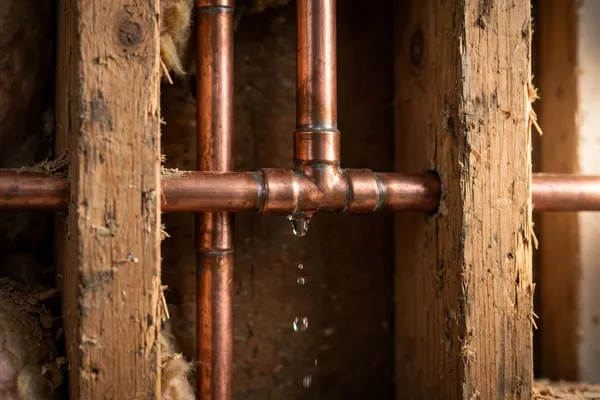
Joints deserve their own word. More leaks start at joints and fittings than in straight pipe. Every change of direction is a joint. Every fixture connection is one too. Age and movement work on those points first. The section testing treats each joint as a suspect.
One last check closes the visit. The sections beside the failing run are retested. A second, smaller loss can hide behind a big one. It would barely move the readings while the main failure ran. With the main failure isolated, a second drop would show. Finding one leak should never mean missing another.