Signs
Signs of a slab leak
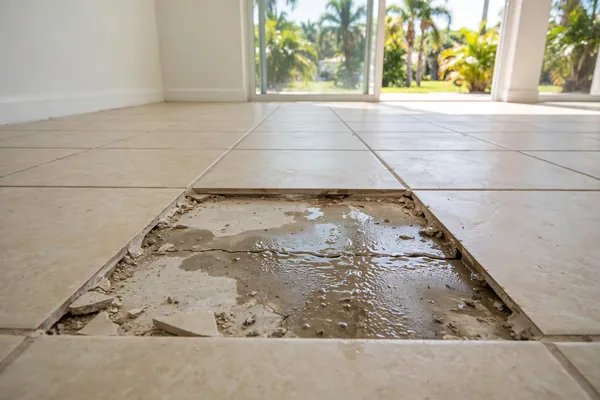
You cannot see a slab leak. But it leaves signs you can check at home. A warm or hot spot on tile or hard flooring. Nothing near it explains the heat. Your meter dial spins while every tap is off. You hear running water when the house is quiet. Baseboards feel damp. Grout changes color, or flooring starts to lift. Your water bill will not come down, month after month. Cracks or uneven patches appear in the flooring. One sign alone can have another cause. Two or more together make a test worth running. The short slab leak signs guide sets out each sign, and what else it could mean.
Read the signs in pairs, and they sharpen. A warm spot above a hot line is the classic slab signal. It means hot water is escaping under the floor, all day and all night. A meter that spins with every tap off means the loss never rests. Damp baseboards and darkening grout mean the water has reached the walls. Lifting flooring means it has been there a while. The bill is the slowest sign of all. It rises month after month, and it never names the place. The tests do that.
One sorting question helps before any test. Is the water coming from under the slab, or from a fixture above it? A leaking toilet seal or a cracked shower pan wets the floor from above. Those are room problems, not slab problems. The signs can look alike at first glance. The meter and the pressure test separate them cleanly. Only a loss inside a pressurised under slab line is a slab leak.
The Trail
Why the wet spot is often not the leak
Owners often expect the damp patch to sit right over the break. Under a slab, it often does not. Many under slab lines run inside a casing or sleeve. The casing is a larger pipe that carries the water line through the slab. When the inner line leaks, the water runs inside that casing. It travels until it finds a weak point, then it surfaces. So the wet spot can sit feet away from the failure. Heat can mislead the same way. A warm trail follows the line, not just the leak point. That is why the technician never marks from a surface sign alone. The mark waits for the readings to agree.
The Method
How we confirm a slab leak
Our specialist finds the leak from the surface. Your floor stays closed while the work goes on. A slab leak gets confirmed in four steps. Step one: the expert splits the system at the manifold. The manifold is where your water splits into hot and cold lines. One line gets closed off at a time. That shows which line is failing, before any floor work comes up. Step two: the specialist pressure tests each line. A line that cannot hold pressure is losing water. How fast it loses pressure shows how active the leak is. Step three: the floors get scanned with a heat camera. A leaking hot line leaves a warm trail across the slab. Step four: the specialist listens through the slab, over the suspect area. Sound equipment picks up the noise of escaping water. The floor gets marked only where all the readings agree. That rule keeps any floor opening to one place.
Each step answers a different question. The manifold split answers which line. The pressure test answers whether that line truly loses water. It cannot say where. The heat scan answers where the warm water runs. It only works on a hot line, though. A cold line leaves no heat trail. The listening step answers the exact point. It needs the line isolated first, so no other sound competes. Put together, the steps corner the leak. One step alone can mislead. All four agreeing cannot.
One more split happens at the start. The technician separates the slab lines from any yard or irrigation feed. An outdoor loss spins the same meter as a slab leak. Blaming the slab for a yard loss would open the wrong ground. So the outdoor side is cleared before the floor work begins.
Most slab leaks start with corrosion in cast iron or copper lines. Soil shifting in the sand plays a part too. So does pressure stress on the lines. The slab leak causes guide sets out how each cause is told apart. Sometimes the failed line sits buried outside the slab, not under it. Buried lines like that are traced by underground water leak detection.
The Report
After detection: the report and the decision
Here is what you get at the end. A marked spot on your floor, where the leak is. And a written report. The report covers four things: which line failed, the pressure readings, the heat and sound evidence, and the exact point. What you do next is your call. The slab leak repair options guide sets out each route, and what it means for your floor. The specialist's detection job ends at the confirmed spot.
The report also becomes your proof for anyone else involved. If the damage goes to your insurer, the report is the detection record behind the claim. The insurance claim documentation guide shows what to keep, and how the report fits the claim file. A plumber quoting the opening also works from the same page. One document serves every decision that follows.
Same Day Priority for Active Leaks
Call for slab leak detection in Pompano Beach
An active slab leak keeps losing water under your floor. Do not wait on it. Call (754) 346-1772 and tell us what you have seen. We plan the tests around your home, one line at a time.
Address: 120 SW 15th St, Pompano Beach, FL 33060 · Serving all Pompano Beach neighborhoods and Broward County
Clear Answers
Frequently asked questions
Does slab leak detection damage the floor?
No. Your floor is not opened to find the leak. Every test works from the surface. Our expert tests the lines, scans the floor for heat, and listens through the slab. The mark shows the one spot for any later opening. That opening only happens if you choose a repair.
Which line is leaking, hot or cold?
That gets settled before pinpointing starts. The specialist splits the system at the manifold, then pressure tests the hot line and the cold line one at a time. The line that loses pressure is the leaking one. So only the failing line gets worked on.
A warm floor spot is the only sign. Is that enough to test?
Not always. A warm spot can be normal. A hot line under the floor warms the spot as water runs through it. The meter reading and the pressure test tell the truth. They show whether a line is really failing.
Can a slab leak wait?
It should not. An active leak under your slab keeps losing water. The lost water washes away the sand that beds the slab. That weakens the support under your floor, and under the slab above it. Active leaks get same day priority. Call (754) 346-1772.
Why does the water surface far from the actual leak?
Because the water travels before it surfaces. Many lines run inside a casing under the slab. The leak runs along that casing and comes up at a weak point. So the damp patch can sit feet from the break. The mark comes from the readings, never from the damp patch alone.
Local Housing
Pompano Beach slabs and housing eras
Most homes here are built slab on grade. That means the house sits right on the concrete slab. The pipe material under your floor matches the era your home was built in. Older neighborhoods have galvanized and copper lines. Newer homes, built as the city grew, have copper and CPVC. The era matters because it changes where lines run. It also changes how they fail. So the technician's check starts with the era of your home. The same era check runs area by area, across every neighborhood we serve.
The waves are easy to read once you know them. The oldest homes carry galvanized supply lines and cast iron drains. Copper took over through the middle decades, for supply lines above and below the slab. Many cast iron drain systems from the 1950s to the 1970s are still in service today. Later builds and remodels brought CPVC and PEX. Each wave fails in its own way, and each hides in its own places. That is why the era shapes the test plan, not just the history.
That same era picture repeats across the county. Homeowners further south use slab leak detection in Fort Lauderdale, and those to the north use slab leak detection in Deerfield Beach, with the test plan set by the era of the home in the same way.