Leak Detection in Pompano Beach, FL

(754) 346-1772
Water line leak detection in Pompano Beach, FL, residential water meter and main supply line

Pompano Beach, FL · Water Line Leak Detection

Water Line Leak Detection in Pompano Beach, FL

Pressure fades at every tap. The meter turns while the house sits shut down. The bill rises, though every indoor check comes back clean. Those signs point at one line. It is the main water line. It runs from the meter to your building. Every other line in the home depends on it. When it fails, the whole property feels it. And the line is buried for most of its run. So the failure hides in the sand, like other underground losses here. Our specialist separates that run from the rest of the system, proves the loss sits on the main line, and pinpoints the failing stretch. You get it all in a written report.

01

Same-day priority

A failing main line wastes water every minute and can starve the whole property of pressure. Active main line losses move first.

02

One question, answered

Is the leak on the main supply, a branch, or inside? Isolation testing answers that before anyone digs or opens a wall.

03

Digital pressure readings

The specialist measures pressure decay with transducers, not impressions, and the readings go in your report.

04

Written main line report

Which segment is losing, where it is, and the test evidence, documented for your records and bill adjustment.

When the Main Line Leaks

The water bill jumps. One patch of the yard stays soggy. Pressure drops at the taps. A break in the buried line can cause all three. Our expert starts at the meter, separates the main run from the indoor system, and separates any irrigation branch too. Then the run gets tested, section by section, until the failing stretch shows itself.

The Sign

Pressure loss as a sign

When pressure falls across the whole property, think of the main line first. A failing main run loses water before the supply reaches the building. So every tap and shower feels the drop at the same time. Pressure loss at one tap, or in one bathroom, is a different pattern. That one points inside the system instead. Sorting the two patterns is the first step. The sign comes first. Then the test proves it. Work through that full check yourself in the low water pressure diagnosis guide: look-alikes first, then the meter test.

The pairing matters as much as the drop. Pressure loss plus a moving meter is a strong pairing. Pressure loss plus a rising bill is stronger still. Pressure loss alone, with a still meter, points elsewhere. A valve partly closed can do it. So can a failing fixture or a clogged filter. Those look-alikes are checked and ruled out first. Here, the question stays narrow. Is the main run itself losing water? The isolation test answers exactly that.

The meter tells the same story in numbers. With every tap closed, a healthy system leaves the meter still. A main line loss keeps it creeping. The creep can be slow. A small split loses a little water all day, every day. Given a month of billing, a little becomes a lot. You can run that meter check yourself before calling: the water bill and meter testing guide walks through it step by step.

A main line split rarely stays the same size. Water under pressure works at the opening, day after day. Sand around the break washes away, and the loss grows. So the pattern often worsens over a season. Pressure that dipped slightly in spring can sag badly by autumn. A worsening trend is itself a sign worth testing.
The Setting

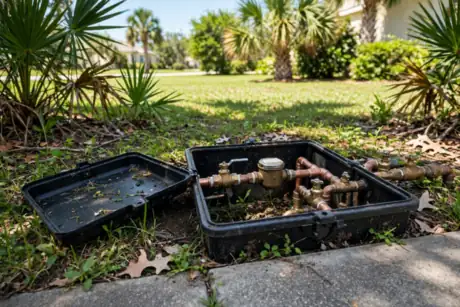
The main line, from meter to building

The main line has one job. It carries the full water supply from the meter to the building entry. Yard lines and branch lines split off from it. That is why the order of testing matters. First, the indoor system is proven clean. Then the branches are checked. Last, the main run is tested on its own. That order keeps the answer clear. Yard lines run in open ground. The methods for those lines, including listening for leaks from the surface, sit with underground water leak detection.

The meter is also the legal seam of the system. The City of Pompano Beach locates only the lines it owns. Those sit in the right of way or in city easements. Everything from the meter toward the building is located privately, at the owner's cost. The city makes one more point owners miss. Water that passed through your meter is water you pay for, leak or not. The customer service manager can explain how that is handled. So a main line loss is both a repair problem and a billing problem. The report speaks to both.

The run is usually the oldest pipe on the property. It was buried when the home was built, and it has worked unseen ever since. Nothing about it shows until it fails. That is why its test is a process, not a glance.

The Method

How the line is located and isolated

The work starts by tracing the run. The specialist establishes the line's path from the meter to the building entry. Driveways, planting, and later additions often hide the original route. Valves at the meter and at the building give the cut points. Once the path is known, the isolation begins. The indoor system is shut off and proven first. Then any irrigation or yard branch is separated. What remains is the main run alone, meter to building.

Then the run is pressure tested in sections. The technician closes off one stretch at a time and pressurises it, watching whether the stretch holds or falls. A stretch that holds is cleared. A stretch that falls carries the loss. The failing stretch then gets split smaller, and tested again. Listening along the traced path then narrows the spot. One honest limit applies. A pressure fall proves the stretch loses water. It does not name the joint. The listening and the surface signs close that last gap.

Much of the run often passes under the driveway or a walkway. Testing does not stop at the concrete edge. The expert tests the stretches on both sides of a crossing separately. That shows whether the loss sits under the surface or in open ground. The answer changes the repair talk completely. An opening in soil is one job. An opening through a driveway is another.

Local Factors

What stresses a main line in Pompano Beach

Sand and soil shift around a buried line, year after year. Roots from mature street trees press on the joints, and can grow into them. Age plays its part too. The line material follows the era the home was built. Older metal lines corrode from the inside out. High incoming pressure works the line hard, day after day. None of this is assumed from the age of the street. Each factor is judged on the readings from your actual run.

Each stress leaves a different fingerprint. Soil shift bends a rigid line slowly, until a joint gives. Roots gather where a joint already weeps, drawn by the moisture. Corrosion thins a metal wall from the inside, over years. High pressure works the line around the clock, with no rest at night. The era of the home hints at which stresses apply. Galvanized service lines from the oldest homes fail by corrosion most often. The readings on your run decide which story is true.

The Report

The report

The written report records how the run was isolated. It lists the pressure readings, section by section. It names the stretch of line that failed. And it holds the meter evidence. The repair decision is made from this document. A city leak adjustment request leans on the same evidence, when the loss sat on your side of the meter. The report also states the boundary, city side and owner side, just as the meter setup shows it.

It also records the marked stretch and its depth where that could be measured. So the opening, when you choose it, lands on the failing stretch only.

Same Day Priority for Active Leaks

Call for water line leak detection in Pompano Beach

A failing main line loses water every hour it runs. Call (754) 346-1772 and tell us what the pressure and the meter are doing. Our specialist starts at the meter and tests the run in order. Active leaks get same day priority.

Address: 120 SW 15th St, Pompano Beach, FL 33060 · Serving all Pompano Beach neighborhoods and Broward County

Clear Answers

Frequently asked questions

How is a main line leak proven, rather than suspected?

By isolation. The technician shuts off the indoor system and the branches, one by one. If the meter still turns, the loss sits outside them. If the main run then cannot hold pressure, the loss is on the main line. That is proof, not a guess.

Does low pressure always mean a main line leak?

No. Low pressure has several causes. The main line test proves or clears the main run itself. It does not guess at the rest.

Where does the city responsibility end and the owner responsibility begin?

At the meter for your property. The supply side belongs to the city system. The run from the meter to the building belongs to the property. The report states which side the confirmed failure sits on.

What happens after pinpointing?

You receive the marked section of line and the written report. Then you decide the repair route, with that evidence in hand. Detection ends at the confirmed location.

Can the line be located and marked before any digging?

Yes. The run is traced and tested from the surface. The failing stretch is marked before any digging is discussed. That mark, with the report, is the whole product of the visit. Digging belongs to the repair you choose next.

Call Now · (754) 346-1772